



TOPCon silicon solar cell design is the most widely used technology for fabricating commercial high-efficiency solar cells (SCs). For most commercial applications, polysilicon (poly-Si) based passivating contacts on the rear side are being used. However, the performance of SCs can be improved further if the recombination losses on the front side emitter and under the metal contacts can be either eliminated or minimised. Furthermore, it is essential to understand the fundamental mechanisms and factors that contribute to achieving higher efficiency.
To address this, a study was conducted at NCPRE by Dr Savita Kashyap (Institute Postdoctoral Researcher), under the supervision of Prof. Anil Kottantharayil, in collaboration with Dr Pradeep Padhamnath (former NCPRE student, and currently a Postdoc in Poland). The performance of various TOPCon device structures, considering both monofacial and bifacial configurations with single-side (SS) and double-side (DS) TOPCon structures, was examined (as shown in the figure below). TCAD simulations are a powerful tool for studying these complex structures prior to actual fabrication to study process sensitivities and manufacturability. The model, well-calibrated to published experimental observations, provides valuable insights into the design of high-efficiency TOPCon devices.
An advanced selective-emitter (SE)-based bifacial DS-TOPCon cell is analysed to reduce parasitic absorption and contact resistivity, thereby improving current collection efficiency. By following the SE technology, the optimized device achieved an efficiency of up to 26.7%. We believe this study provides an understanding of the excellent performance of TOPCon devices and could provide a pathway for improving the performance of advanced commercial TOPCon SCs. Based on this work, a paper entitled “Optimizing the Performance of Multi-Structure TOPCon Solar Cells: A Numerical Analysis using Sentaurus-TCAD” has been published in Solar Energy, a peer-reviewed journal in the PV field with an Impact Factor of 6.6.
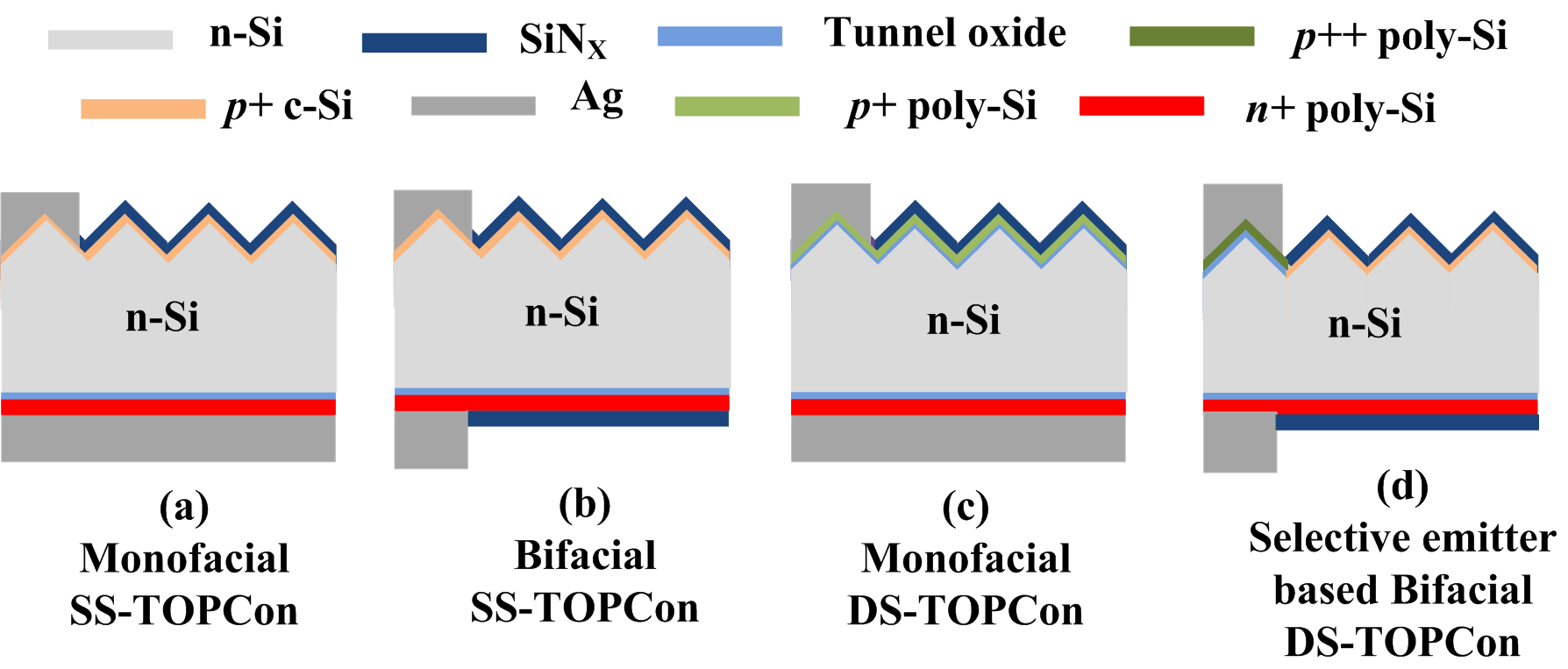
The cross-section schematics of the different TOPCon architectures (a): Monofacial SS-TOPCon, (b) Bifacial SS-TOPCon and (c) TOPCon. p++ is a highly p-type doped poly-Si (dark green colour) used under the front metal contact.